













Trust Roofing Installation Standards
2.08 How to Re-Nail a Wood Deck (Florida Code)
Florida code requirements for re-nailing roof decking, including nail pattern, spacing, and inspection standards before underlayment is installed.

Roofing work involves working at height and requires proper safety equipment and training. The information in this course is intended for educational purposes. Homeowners should consult a licensed roofing professional before attempting roof repairs or modifications.


Other Courses
Overview
Florida building code requires that roof decking be re-nailed to specific patterns before a new roof system is installed on a re-roof. This is not optional — it affects the wind resistance rating of the roofing system and the homeowner's insurance coverage.At Trust Roofing, deck re-nailing is a standard part of every shingle re-roof in Florida. This training covers the code requirements, correct nail pattern and spacing, and how to document the completed work for inspection.
Our Field Standards
Deck re-nailing is required on every Trust Roofing shingle re-roof in Florida.Field standards include:* All deck re-nailing is completed before underlayment installation begins* Ring-shank nails meeting Florida building code specifications are used throughout* The required nail spacing pattern is followed across the entire deck surface* Re-nailing is completed in a grid pattern that can be visually confirmed* Completed re-nailing is photographed for permit documentation* Deck boards with insufficient thickness are flagged for replacement before proceeding
Our Process
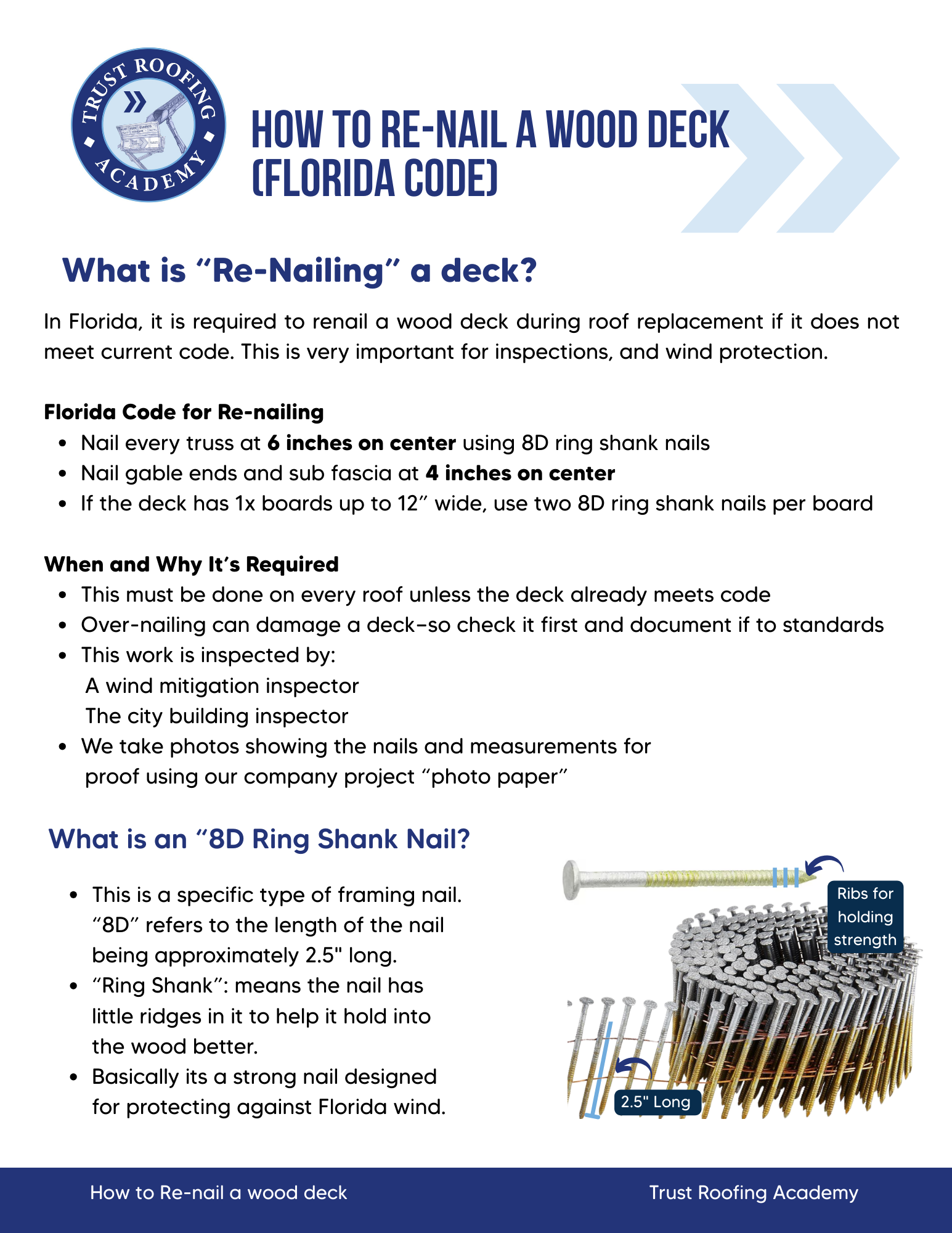
Florida Code RequirementsFlorida building code requires:* Ring-shank or screw-shank nail type* Spacing requirements vary by jurisdiction — confirm with the project manager before starting* Most standard re-roofs require nails at 6 inches on center along panel edges and 12 inches in the fieldThe Re-Nailing Process1. Begin at one corner and work in organized rows2. Snap chalk lines to establish the correct nail grid3. Drive nails flush — not over-driven, which damages the panel4. Work across the full deck surface without skipping sections5. Inspect each row before moving to the nextDocumentation* Photograph the completed re-nailing before underlayment is installed* Note the nail type and spacing in project documentation* Confirm with the project manager that the pattern meets permit requirements
Roofing Terms
Florida Building Code (FBC)
The statewide construction standard that governs all roofing installations, including deck re-nailing requirements, fastener types, and spacing patterns required before a new roof can be installed on a re-roof project.
Ring-Shank Nail
A nail with circular grooves along the shank that provide significantly increased holding power compared to smooth shank nails, required for deck re-nailing under Florida building code.
Wind Resistance Rating
The certified ability of a roofing system to withstand wind uplift forces, directly affected by the deck fastening pattern, and tied to the homeowner’s Florida wind mitigation insurance discount.
Deck Re-Nailing
The process of driving additional ring-shank nails into the roof deck panels before underlayment is installed, required by Florida building code on re-roof projects to improve wind uplift resistance.
Wind Mitigation Inspection
A formal inspection performed by a licensed inspector that documents the wind-resistant features of a roofing system, including the deck fastening pattern, to qualify the homeowner for Florida insurance discounts.
Need more help?
We've built a library of resources for homeowners, property managers, and those looking for roofing help.
View Resources