





Trust Roofing Installation Standards
4.04 How to Lay Out TPO Rolls (Mechanically Fastened)
How to measure, roll out, and position TPO membrane sheets correctly for a mechanically fastened system before seaming and welding.

Roofing work involves working at height and requires proper safety equipment and training. The information in this course is intended for educational purposes. Homeowners should consult a licensed roofing professional before attempting roof repairs or modifications.


Other Courses
Overview
TPO membrane layout is the planning and positioning phase that determines whether a mechanically fastened TPO roof is installed efficiently and correctly. Before a single fastener is driven or a seam is welded, the membrane must be rolled out, positioned, and aligned correctly across the entire deck.At Trust Roofing, proper TPO layout minimizes waste, ensures seams fall in correct locations, and sets up the welding process for success.
Our Field Standards
TPO layout follows Trust Roofing field standards for mechanically fastened systems.Field standards include:* Layout planning is completed before any rolls are opened — confirming roll direction, seam placement, and waste management* Rolls are oriented so seams run parallel to the roof slope — water flows across seams, not into them* Seams are positioned a minimum of 12 inches from drain bowls, curbs, and penetrations* The first roll is positioned square to the building and confirmed before subsequent rolls are positioned* Membrane is allowed to relax in the sun before fastening — do not fasten membrane fresh from cold storage* Each roll is confirmed correctly positioned before the next roll is unrolled
Our Process
Planning the LayoutBefore opening any rolls:* Measure the roof dimensions and calculate the number of rolls required* Determine the roll direction — parallel to the slope* Plan seam locations — avoid drains, curbs, penetrations, and perimeter edges* Identify where partial rolls will be requiredUnrolling and Positioning1. Begin at one edge of the roof2. Unroll the first sheet in the planned direction3. Confirm the sheet is square to the building — measure from each edge4. Allow the sheet to relax on the deck for 30 minutes before fastening in cold weather5. Position subsequent sheets with the planned overlap — typically 6 inchesManaging Overlaps* Consistent 6-inch overlap on all seams for mechanically fastened systems* Fold back the top sheet at each seam to access the fastener zone below* The fastener strip is installed on the lower sheet before the upper sheet is unrolled over itCommon Layout Errors* Seams too close to drains or curbs* First roll not square — everything else will compound the misalignment* Rolls not allowed to relax — membrane will shrink after fastening* Overlap inconsistent — too-narrow seams cannot be welded properly
Roofing Terms
TPO (Thermoplastic Polyolefin)
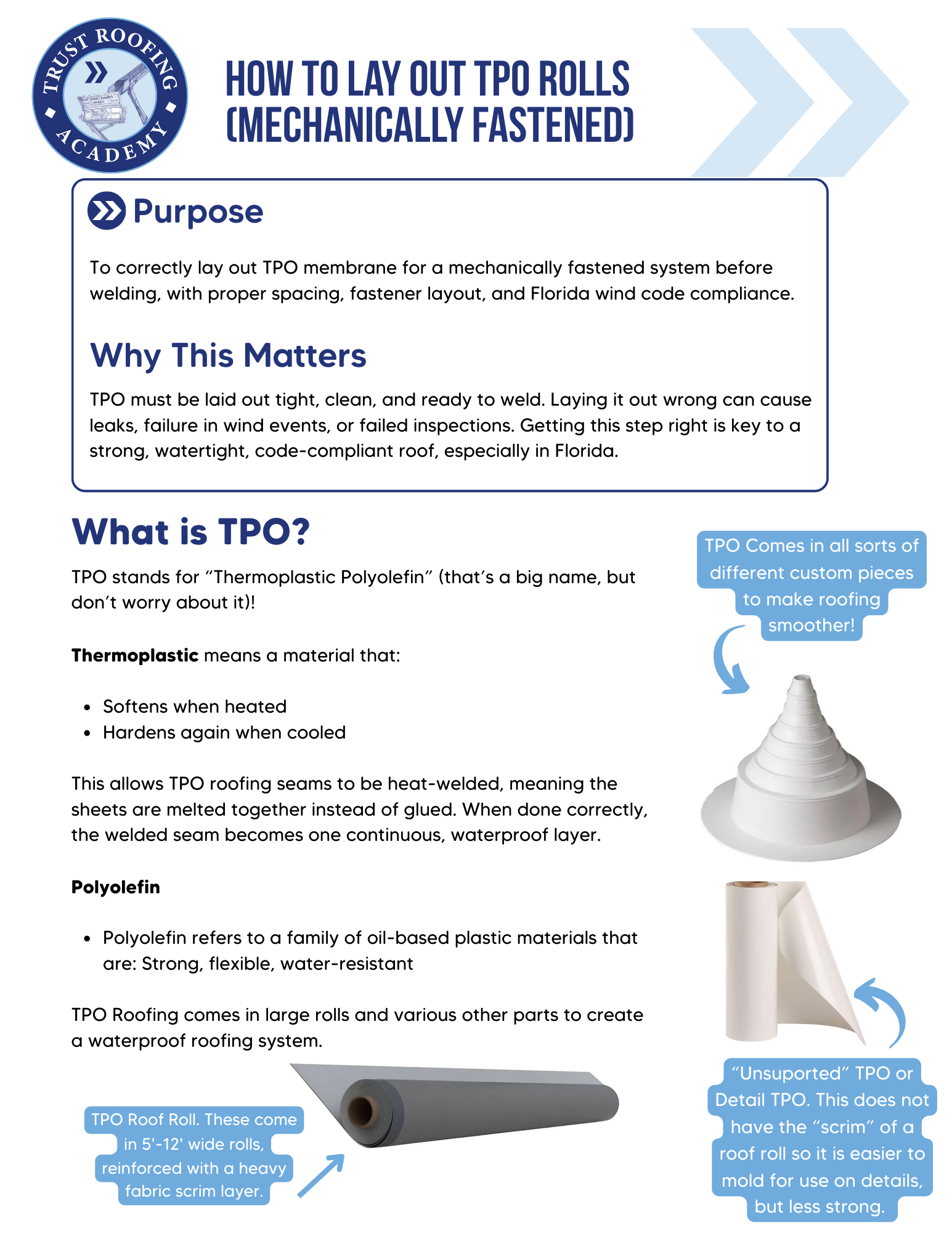
A single-ply thermoplastic roofing membrane installed on flat and low-slope roofs, fused at seams using hot air welding to create a continuous, watertight waterproofing layer. The most widely used flat roofing membrane in Florida.
Mechanically Fastened System
A TPO installation method where the membrane is secured to the roof deck using metal fastener plates at the seam overlap, the most common TPO installation method used by Trust Roofing on residential and light commercial flat roofs.
Seam
The joint where two sheets of TPO membrane overlap, the most critical waterproofing detail in a TPO system, made watertight through hot air welding. Seam quality is the primary determinant of flat roof performance.
Florida Wind Uplift Resistance
The ability of a TPO roofing system to resist the upward pressure exerted by wind during a storm, determined by fastener density, fastener plate size, and seam integrity. FBC specifies minimum uplift resistance requirements by wind zone.
Membrane Relaxation
The process of allowing TPO rolls to warm and relax on the roof deck before fastening, critical in cooler conditions because cold membrane will shrink after fastening, creating tension at seams that compromises weld quality.
Need more help?
We've built a library of resources for homeowners, property managers, and those looking for roofing help.
View Resources